

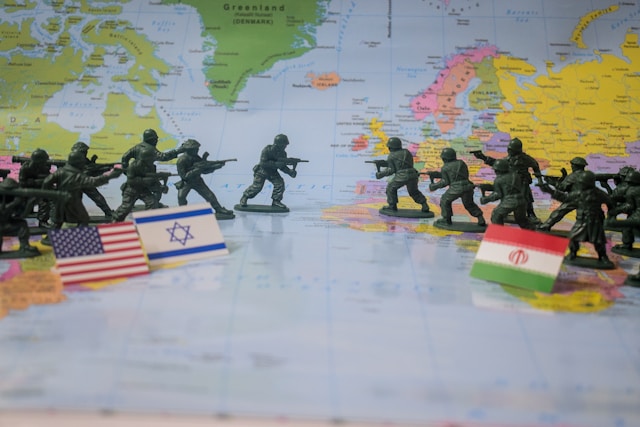
The Iran-Israel-USA conflict of March 2026 has rapidly become one of the most dangerous geopolitical crises in recent decades, with profound consequences for the Middle East and the world. What started as a sudden and intense military operation has quickly escalated into a full-blown clash involving airstrikes, missile attacks, and regional spillover. By early March, the situation was entering its fifth day of active warfare, with combat actions not only inside Iran but across multiple countries and waters of the Gulf.
The immediate spark of this conflict was a coordinated campaign of airstrikes launched by the United States and Israel on Iran, aiming to dismantle military and strategic infrastructure. These strikes targeted missile sites, air defence systems, naval assets, and command installations. Within the first 100 hours of the operation alone, U.S. and Israeli forces struck nearly 2,000 targets, underscoring the scale and intensity of the offensive.
Death of Supreme Leader
The opening hours of war brought an unprecedented development: the death of Iran’s Supreme Leader, Ayatollah Ali Khamenei, in the initial wave of strikes. This death was confirmed by multiple international sources and instantly removed a central figure in Iranian politics and military decision-making. It also fueled Iranian resolve for retaliation.Iran’s response was swift and widespread. Rockets, ballistic missiles, drones, and missile boats were launched at Israeli territory, US forces stationed in the Gulf, and other regional targets. Iranian proxies and allied militias, such as Hezbollah in Lebanon, also fired rockets into northern Israel. Over the first several days, Iran’s waves of attacks were described as “massive”, with dozens of ballistic missiles and drones targeting cities, bases, and infrastructure.
The human cost of this conflict has been staggering. According to reports from rights organisations and media outlets, more than 1,000 civilians in Iran have been killed during the early phases of bombardment, including at least 181 children. Thousands more have been wounded, with some estimates of over 5,000 casualties being investigated. Residential neighbourhoods, hospitals, and schools have been hit, raising deep concerns among humanitarian organisations about civilian protection and respect for international law.
On the Israeli side, civilian casualties have also occurred, with direct hits reported in cities like Tel Aviv, Haifa, and Beit Shemesh, though the number has been significantly lower than in Iran. Reports indicate that at least 11 people have died in Israel from Iranian retaliation strikes.
This direct confrontation between Iran, Israel, and the United States marks a serious escalation compared to earlier proxy conflicts and tensions that have simmered for years. In recent history, Iran’s backing of militant groups and its nuclear ambitions have been longstanding points of contention with both Washington and Jerusalem. What distinguishes this moment is the transition from indirect engagements to overt military operations on a vast scale.
The military dynamics on the battlefield have also shifted. By early March, U.S. and Israeli forces claimed to be exercising control over most of Iranian airspace, a statement that reflects both aerial dominance and the intensity of strikes aimed at crippling Iran’s air defence systems. Despite this, Iranian forces retained some capabilities, often operating from underground facilities, complicating the strategic picture for U.S. and Israeli planners.
Beyond the direct combat, this conflict has had immediate and disruptive effects across the wider Middle East region. Iran’s closing of the Strait of Hormuz — the world’s most critical oil-shipping lane — was reported, sending shockwaves through global energy markets. The strait is a chokepoint through which nearly a fifth of the world’s oil supply normally transits. Interruptions to shipping have already contributed to rising oil prices and heightened volatility in global markets.
Several Gulf states, including the UAE, Bahrain, and Kuwait, reported missile or drone strikes on their territory or nearby waters, illustrating how quickly this conflict has transcended Iran and Israel’s borders. Airspace closures, disruptions to commercial flights, and evacuations of foreign nationals have followed, disrupting travel and trade. UK and European airspace over the Arabian Gulf saw cancellations and rerouting of flights, indicating the far-reaching impact on civilian commerce.
Economic Situation
Economic consequences extend to Israel as well. The Israeli Finance Ministry projected severe economic losses due to the conflict, estimating that the ongoing military situation could cost the economy nearly 9 billion shekels (about $2.93 billion) per week under current emergency conditions. School closures, travel limitations, and the mobilisation of reservists have all contributed to this slowdown. Some policymakers are considering transitioning to a lower alert status to reduce economic damage, though the strategic calculus remains fraught.
Diplomatically, the conflict has drawn mixed reactions worldwide. Some countries and blocs have condemned the strikes and called for a ceasefire, while others have expressed support for U.S. and Israeli actions against what they describe as Iranian provocations. The European Union has warned of broader implications for global security, particularly if the war continues to spread or draws in additional state actors.
At the United Nations, emergency sessions have been convened to address the escalating violence. International leaders are increasingly vocal about the dangers of this conflict spiralling into a larger war that could involve other regional powers. Discussions range from possible diplomatic interventions to humanitarian assistance for displaced populations, particularly in places like Lebanon where tens of thousands are reported to be displaced as a result of cross-border fighting.
One of the most worrying aspects of this conflict is its potential to entrench long-term instability in the Middle East. Experts suggest that the destruction of critical infrastructure, deepening mistrust among regional actors, and disruptions to everyday life could reshape Gulf security calculations for years. The United States and Israel have framed their campaign as necessary to neutralise what they view as persistent and existential threats from Tehran, including its missile programs and support for militant groups. Tehran, on the other hand, has portrayed its retaliatory actions as defensive and a response to what it calls unjust aggression.
As the war enters its second week, the international community faces difficult questions about how to resolve the conflict, protect civilians, and prevent further escalation. The path forward remains uncertain. Negotiations and ceasefire proposals are being floated, but there is no clear moment when either side might step back. Until then, the Middle East remains caught in a perilous moment where the consequences of war extend far beyond battlefields, affecting economies, societies, and the geopolitical balance of an entire region.
Post a comment
0 comments