

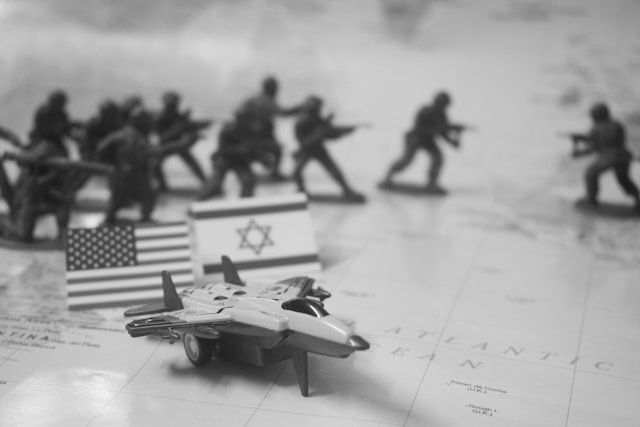
The joint military campaign launched by the United States and Israel against Iran in early 2026 has marked one of the most dramatic episodes of conflict in the Middle East in recent memory. What began as a series of coordinated airstrikes and precision attacks has quickly evolved into a broader confrontation with deep implications for military strategy, regional security, and the political future of the Middle East. As the war enters its second week, it is clear that the strategic goals and next moves of both the United States and Israel will shape not only the outcome of the conflict but also the geopolitical landscape of an entire region.
At the heart of the military strategy is a massive set of attacks carried out under operations that have been described as the largest U.S. military buildup in the Middle East in a generation. In the first 100 hours alone, U.S. and Israeli forces struck nearly 2,000 Iranian targets, including missile sites, air defense installations, naval assets, command centers and strategic military infrastructure deep inside the country. This campaign relied on a combination of traditional airpower, long-range missiles, carrier strike groups, and coordinated operations involving tens of thousands of troops and hundreds of aircraft. The goal, according to senior officials, was to degrade Iran’s ability to project power, disrupt its missile and drone capabilities, and exert strategic pressure on its leadership.
The scale and intensity of these strikes reflect a shift away from past approaches that relied heavily on containment and proxy warfare through allied groups in countries such as Iraq, Lebanon and Yemen. Instead, U.S. and Israeli planners appear to be pursuing a strategy aimed at neutralizing perceived direct threats at their source rather than allowing Iran to continue developing long-range missile arsenals, drone swarms and other asymmetric capabilities that could menace Israel and American forces across the Gulf. This strategy has included targeting command and control facilities as well as air defense systems to establish air superiority. By early March, Israel’s UN envoy reported that U.S. and Israeli air forces had gained control over most of Iranian airspace, signaling a continuing focus on dominance from above.
Israel’s involvement in this campaign stems not only from security concerns but from decades of tension with Tehran over nuclear development, support for militant groups, and repeated threats against Israeli territory. Israeli Prime Minister Benjamin Netanyahu has publicly stated that the conflict may take “some time” but is not expected to drag on for years, framing it as a targeted effort to degrade Iranian capabilities rather than a long-drawn ground invasion. He has also suggested that this conflict could catalyze changes within Iran that align with broader regional security goals, including weakening what he and other Israeli leaders see as an existential threat.
For the United States, the strategy encompasses both military pressure and political signalling. U.S. military leaders have emphasised that their operations are focused on eliminating imminent threats to regional stability while attempting to avoid a prolonged ground war. The Pentagon has described the campaign as involving assaults “from seabed to space and cyberspace,” highlighting the multidimensional nature of modern warfare in which military success is measured not only on physical destruction but also dominance in information, cyber, and electronic domains.
Yet, the military strategy has not been without controversy or complexity. Iran’s retaliatory attacks, consisting of ballistic missiles, drones, and strikes against allied targets across the Gulf, including Bahrain, Kuwait and other U.S. bases—have demonstrated Tehran’s ability to strike back in ways that complicate the U.S. and Israeli strategic script. These actions have underlined that, despite heavy bombardment, Iran retains operational capacity and regional influence that extends through proxy groups and its own military branches.
One of the most striking elements of Iran’s response strategy has been its effort to impose significant costs on its adversaries rather than seeking a simple battlefield victory. Iranian official statements and analysis from regional commentators suggest Tehran intends to raise the wider price of conflict for its enemies by using asymmetric tactics, targeting not only military bases but also shipping lanes and regional infrastructure to disrupt normal economic and strategic operations. Such strategy could prolong tensions and make the conflict harder to definitively close through military means alone.
The death of Iran’s Supreme Leader, Ayatollah Ali Khamenei, in the initial phase of the war—reported by multiple sources—added another layer of uncertainty to this strategic calculus. Without his leadership, Iran’s internal political dynamics may shift, potentially consolidating power among hardliners or triggering internal contention over succession. This outcome could influence Iran’s military posture and its willingness to negotiate or escalate further in response to external pressure.
Looking ahead, analysts and experts widely agree that the next phase of this conflict will not solely be determined by military actions on the battlefield but by a complex interplay of diplomatic, economic and regional alliances. The war has drawn concern from international actors including the European Union and neighbouring states who fear wider escalation. Some have called for diplomatic interventions and ceasefires, while others balance condemnation with strategic hedging in support of allied interests.
Another key strategic factor will be the role of regional proxies and allied militias, including Hezbollah in Lebanon. The expansion of hostilities into Lebanese territory, with rocket fire and counter-strikes, illustrates how the conflict has already spilled beyond the direct US-Iran-Israel theatre, involving a variety of actors with differing objectives. These engagements have the potential to widen the war and make resolution more complicated, as each additional front brings its own set of political costs and civilian consequences that shape public opinion across the region.
The military strategy must also contend with broader global ramifications. The disruption of key shipping routes like the Strait of Hormuz, where a significant portion of the world’s petroleum passes, has already had economic effects on energy markets and shipping costs. Any prolonged closure or continued threat in these waterways could force strategic shifts in global energy supply chains, further entrenching the war’s impact on world markets.
As policymakers and military leaders assess their next steps, many questions remain unanswered. Will the U.S. and Israel push further toward a regime change objective, or will they seek negotiated terms designed to reduce direct confrontation? Can diplomatic pressure from global powers slow the conflict and protect civilian populations? And how will Iran respond over the long term to sustained military onslaught and internal leadership changes? These questions underscore the depth and seriousness of the conflict’s implications.
In conclusion, the military strategy of the United States and Israel in the Iran war reflects a determination to degrade what they see as immediate threats while maintaining air and technological superiority. However, Iran’s asymmetric response, regional alliances, and wider geopolitical pressures mean that the conflict is far from a quick or simple military campaign. What happens next will likely shape the Middle East for years to come, influencing security arrangements, diplomatic relations, and the balance of power in one of the most volatile regions of the world.
Post a comment

0 comments